Cruise Ship Terminology
& Dictionary
Understand cruise ship language, job titles, onboard departments, maritime documents, safety terminology, training requirements and life-at-sea vocabulary used throughout the cruise industry.
Search Cruise Ship Terms
Search cruise ship words, job titles, documents, departments, training and life onboard terms.
Most Searched Cruise Ship Terms
Common Cruise Ship Terminology Questions
Helpful answers for new applicants learning cruise ship words, documents, safety terms, contract language and life onboard.
What is embarkation?
Embarkation is the process of joining or boarding the ship. For crew, it usually means arriving at the joining port and starting the sign-on process.
What is disembarkation?
Disembarkation means leaving the ship, usually at the end of a voyage or crew contract.
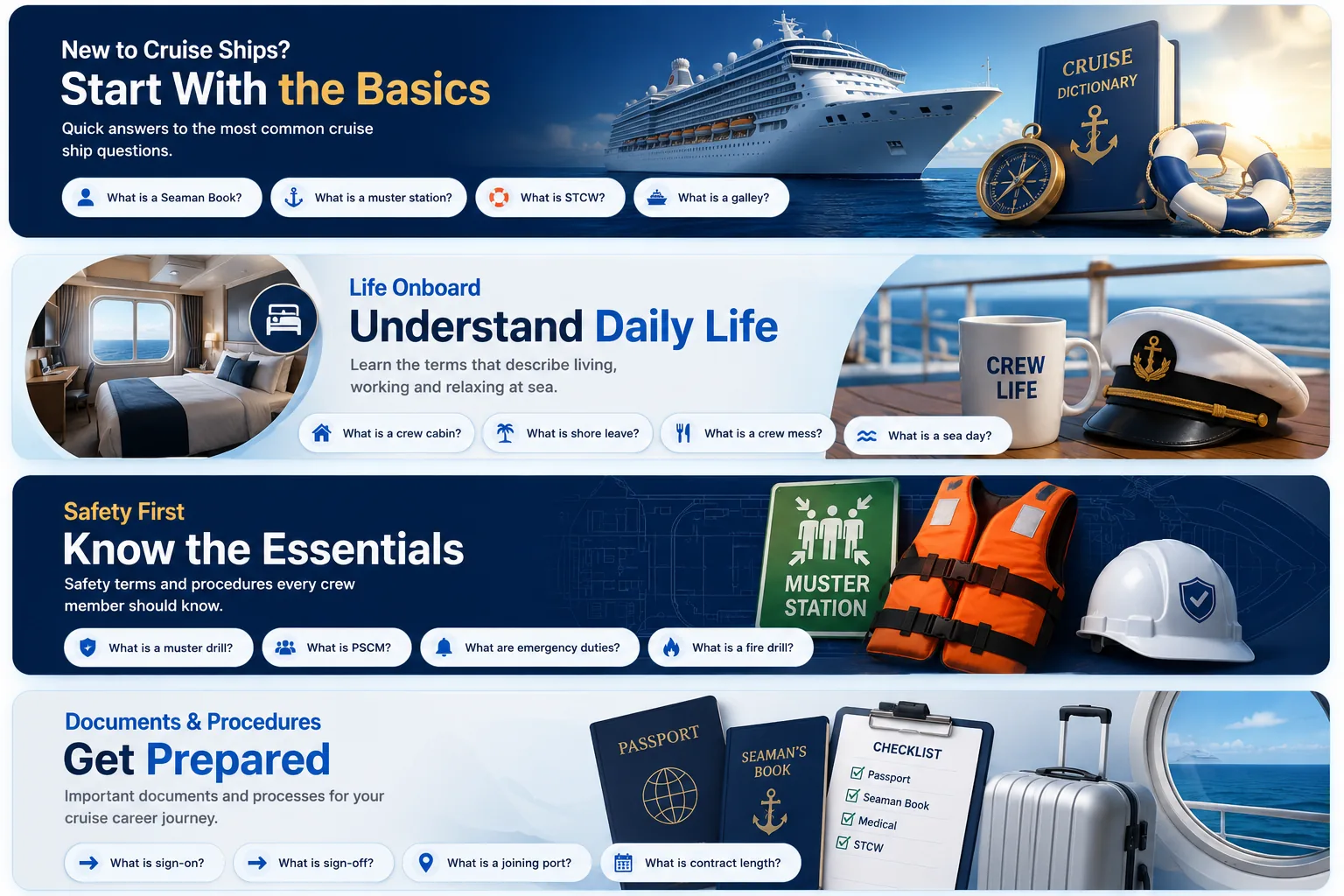
What is a galley on a cruise ship?
The galley is the ship’s kitchen area where food is prepared for guests and crew.
What is STCW?
STCW is international safety training required for many seafarers and some cruise ship positions.
What is a Seaman Book?
A Seaman Book is an official maritime document used to record a seafarer’s sea service and employment history.
What does sign-on mean?
Sign-on means officially joining the ship and beginning your onboard contract.
What does sign-off mean?
Sign-off means officially leaving the ship after completing a contract or being released from duty.
What is a joining port?
The joining port is the port where a crew member boards the ship to start work.
What is a muster station?
A muster station is the assigned emergency assembly area used during drills or emergencies.
What is a muster drill?
A muster drill is a safety exercise where crew and guests practise emergency procedures.
What is PSCM?
PSCM means Passenger Ship Crowd Management. It helps crew manage passengers during safety situations.
What is a crew cabin?
A crew cabin is the onboard living accommodation assigned to crew members during their contract.
What is a crew mess?
The crew mess is the dining area where crew members eat onboard.
What is shore leave?
Shore leave is time off when crew may go ashore in port, depending on duties, ship rules and local regulations.
What is a Bosun?
A Bosun supervises deck crew and assists with maintenance, mooring and deck operations.
What is a Purser?
A Purser is connected to onboard administration, guest services, accounts or documentation.
What is a cabin steward?
A cabin steward cleans and maintains guest cabins and supports guest comfort onboard.
What is a sea day?
A sea day is a day when the ship remains at sea and does not visit a port.
What is a port day?
A port day is when the ship docks at a destination and guests may go ashore.
What does contract length mean?
Contract length is the period a crew member is expected to work onboard before taking leave.
What is repatriation?
Repatriation means returning a crew member home after contract completion or another approved reason.
What is a PEME?
PEME means Pre-Employment Medical Examination. It checks if an applicant is medically fit to work at sea.
What is HACCP?
HACCP is a food safety system used to control hygiene risks in food preparation and service areas.
What is the bridge?
The bridge is the ship’s command area where navigation and vessel control take place.
What is watchkeeping?
Watchkeeping is a scheduled duty where crew monitor navigation, machinery, security or safety systems.
What is a gangway?
The gangway is the controlled access point used to board or leave the ship.
What is a tender port?
A tender port is a destination where smaller boats transport guests or crew between the ship and shore.
What is a crew bar?
The crew bar is a social area where off-duty crew may relax, subject to company rules.
What is a name badge?
A name badge is worn by crew to identify their name and sometimes department or position.
What are grooming standards?
Grooming standards are appearance rules covering uniform, hair, hygiene and professional presentation.
What is an offer letter?
An offer letter confirms a job offer or proposed employment details, usually subject to final checks.
What is assignment?
Assignment means allocating a selected crew member to a specific ship, joining date, port and position.